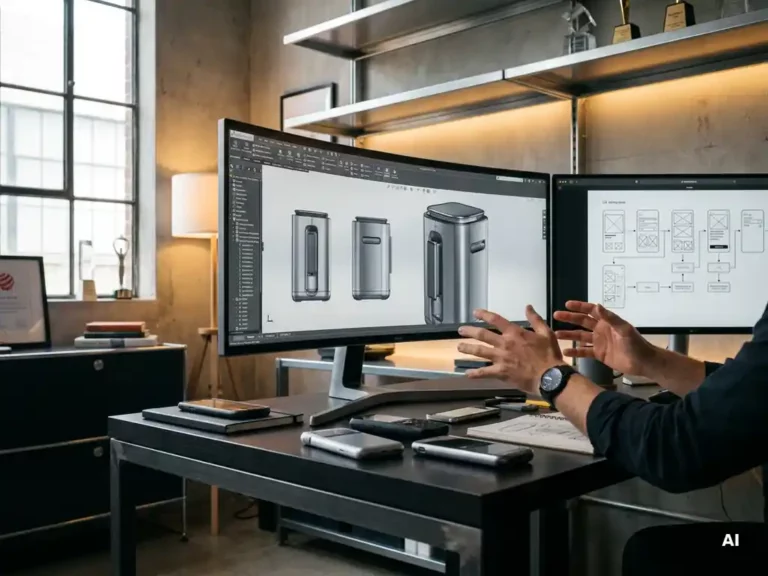
The leading UX trends in industrial design in 2026 center on human-centered design, intelligent digital interfaces, and seamless integration between physical hardware and software ecosystems. These trends are reshaping how manufacturers develop and differentiate their products in competitive B2B markets. The sections below unpack each of these shifts in detail, from foundational principles to the forces that will define the next decade.
How is UX reshaping product development in industrial design?
UX is reshaping product development in industrial design by moving it from a purely engineering-led process to one where the end user’s needs, workflows, and cognitive load are central design constraints. Rather than treating usability as a finishing layer, leading manufacturers now integrate user experience research from the earliest stages of product definition, which directly influences hardware architecture, interface logic, and service design.
This shift has practical consequences for how development teams are structured. Industrial companies increasingly bring UX researchers and interaction designers into cross-functional teams alongside mechanical engineers and software developers. The result is that decisions about form factor, display placement, control logic, and feedback mechanisms are informed by real operator behavior rather than assumed workflows.
For B2B manufacturers, this matters because complex industrial equipment is only as effective as its operators‘ ability to use it confidently and efficiently. Poor UX translates directly into longer training cycles, higher error rates, and slower adoption. Strong product design services treat usability as a performance specification, not an afterthought.
What role does human-centered design play in modern industrial products?
Human-centered design in industrial products means systematically grounding every design decision in a deep understanding of who uses the product, in what environment, under what cognitive and physical conditions, and toward what goals. It is the methodological backbone behind the broader UX trend in industrial design, ensuring that innovation serves real operational needs rather than technical possibility alone.
In practice, human-centered design for industrial equipment involves several distinct activities:
- Contextual user research: Observing operators in real production environments to understand actual workflows, pain points, and workarounds
- Persona and scenario development: Building structured profiles of different user types, from maintenance technicians to plant managers, to guide design trade-offs
- Iterative prototyping: Testing physical and digital concepts with real users early and often, before tooling decisions lock in design directions
- Ergonomic and cognitive load analysis: Evaluating how physical form and interface logic interact with the demands of the working environment
The outcome of this process is not just a more comfortable product. It is a product that operators trust, adopt quickly, and use at full capability. In industrial settings, that translates directly into productivity, safety, and reduced total cost of ownership for the buyer.
How are digital interfaces changing the UX of industrial equipment?
Digital interfaces are fundamentally changing the UX of industrial equipment by replacing fixed, hardware-bound controls with flexible, software-driven interaction layers that can be updated, personalized, and extended over the product’s lifetime. Touchscreens, embedded displays, and connected dashboards are now standard features on equipment that previously relied entirely on physical switches and analog gauges.
This shift introduces both opportunity and risk. On the opportunity side, digital interfaces allow manufacturers to surface complex data in intuitive visual formats, guide operators through multi-step processes with contextual prompts, and adapt the interface to different user roles. A maintenance technician and a production manager can see entirely different views of the same machine, each optimized for their specific tasks.
The risk lies in bringing consumer interface expectations into an industrial context without adapting them. Industrial environments involve gloves, loud surroundings, time pressure, and operators who may interact with the interface infrequently and under stress. Interface design for industrial UX must prioritize clarity, error prevention, and resilience over visual sophistication. The best industrial interfaces are ones that operators barely have to think about.
What’s the difference between UX in consumer design and industrial design?
The key difference between UX in consumer design and industrial design is the user context and the consequences of failure. Consumer UX optimizes for delight, discoverability, and broad appeal across diverse, often casual users. Industrial UX optimizes for efficiency, reliability, and safety in demanding, high-stakes environments where errors can be costly or dangerous.
Consumer UX priorities
Consumer products are designed for first-time users who explore features independently, often without training. UX in this context emphasizes intuitive onboarding, emotional engagement, and aesthetic appeal. The user can walk away from the product if it frustrates them, and the designer’s goal is to prevent that.
Industrial UX priorities
Industrial products are used by trained professionals in structured operational contexts. UX here prioritizes task efficiency, error prevention, and consistency under fatigue or stress. The interface must work reliably with gloves, in low light, and under time pressure. Operators often interact with the same interface hundreds of times per day, so small inefficiencies compound into significant productivity losses. Aesthetics matter for brand positioning and perceived quality, but they are always subordinate to functional clarity.
This distinction also affects how UX research is conducted. Consumer UX relies heavily on large-scale behavioral data and A/B testing. Industrial UX depends more on deep contextual observation, expert interviews, and usability testing in realistic operational conditions, often with small but highly knowledgeable user groups.
How does UX-driven design improve B2B product competitiveness?
UX-driven design improves B2B product competitiveness by creating measurable advantages in adoption speed, operator performance, and total cost of ownership that procurement decision-makers can evaluate and justify. In B2B markets, purchasing decisions involve multiple stakeholders, longer sales cycles, and higher scrutiny of real-world performance. A product with superior UX reduces training costs, lowers error rates, and increases operator confidence, all of which translate into quantifiable value for the buyer.
Beyond operational performance, UX-driven design strengthens brand positioning. In competitive industrial categories where technical specifications between products are often comparable, the quality of the user experience becomes a meaningful differentiator. A product that feels well-engineered, intuitive, and thoughtfully designed communicates competence and investment in the customer relationship.
Design awards and independent recognition play a supporting role here. For B2B buyers evaluating vendors, internationally recognized design quality signals that a manufacturer takes product excellence seriously across all dimensions, not just engineering performance. This is particularly relevant when procurement teams include innovation or product management stakeholders who value design leadership as a proxy for overall quality.
Which UX trends in industrial design will define the next decade?
The UX trends in industrial design that will define the next decade are adaptive interfaces driven by AI, deeper integration between physical products and digital service layers, increased focus on accessibility and ergonomics across diverse operator populations, and sustainability-informed design that considers the full lifecycle experience of the product.
- AI-driven adaptive interfaces: Interfaces that learn from operator behavior and adjust information presentation, alert thresholds, and workflow guidance based on individual usage patterns and real-time conditions
- Physical-digital integration: Industrial products increasingly function as entry points into broader software ecosystems, where the hardware UX and the connected platform UX must be designed as a unified experience rather than separate concerns
- Inclusive and ergonomic design: As workforce demographics shift and global markets expand, industrial UX must account for a wider range of operator profiles, including differences in physical capability, language, and prior technical experience
- Sustainability as a UX dimension: Users and buyers increasingly expect products to communicate their environmental footprint and support sustainable operation. UX that surfaces energy consumption data, maintenance intervals, and end-of-life guidance will become a standard expectation
- Remote operation and assisted reality: Augmented reality tools for maintenance guidance, remote expert support, and operator training are moving from pilot projects to standard product features in many industrial categories
For manufacturers, these trends point toward a future where the user experience of an industrial product is never finished. Products will be continuously updated, improved, and extended through software, making the initial design architecture and the quality of the underlying UX framework more consequential than ever.
How code2design helps with UX in industrial design
We bring over 25 years of experience applying human-centered design principles to complex industrial products, helping B2B manufacturers translate technical innovation into user experiences that drive adoption, strengthen brand identity, and win in competitive markets. Our 360° design approach integrates user research, interface design, and strategic product development into a single cohesive process.
Working with us, you can expect:
- Deep user research: We investigate how your operators and end users actually work, not how they are assumed to work, so every design decision is grounded in real operational context
- Interface and interaction design: From embedded displays to connected dashboards, we design digital interfaces that perform reliably in demanding industrial environments
- Strategic product positioning: We align UX decisions with your brand identity and market positioning, ensuring that the experience your product delivers reflects the values your company stands for
- Full-service development support: From concept through to production-ready design, we work alongside your engineering teams to ensure that great UX survives the development process intact
- Award-winning design quality: With over 75 international design awards, our track record demonstrates that we consistently deliver products that are recognized for both excellence and innovation
If you are ready to make user experience a genuine competitive advantage for your industrial products, we would love to talk. Get in touch with our team to start the conversation.