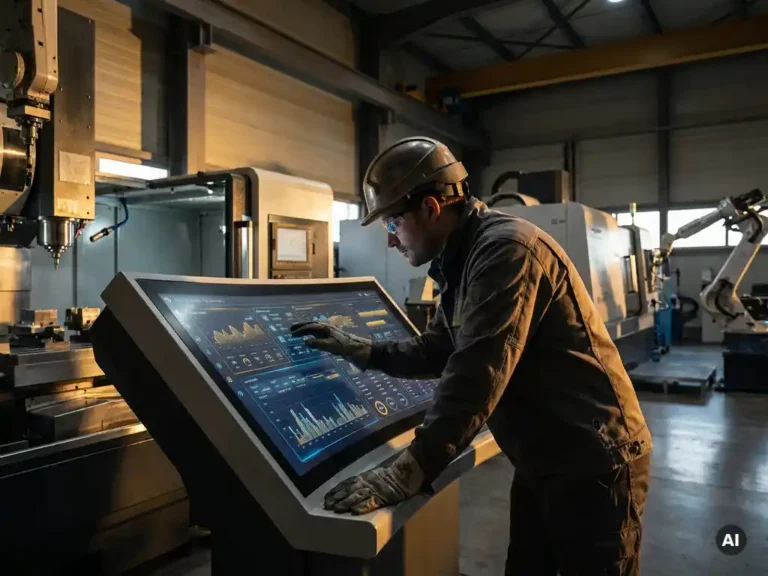
User experience matters for industrial products because it directly affects how efficiently and safely operators can use equipment, how quickly new users reach proficiency, and whether a product delivers on its intended performance in real working conditions. Poor UX in an industrial context does not just frustrate users – it creates measurable losses in productivity, increases error rates, and can compromise safety. The questions below unpack the specific ways UX shapes industrial product outcomes, from adoption and purchasing decisions to the right moment to integrate it into your development process.
How does poor UX affect industrial product adoption?
Poor UX in industrial products slows or prevents adoption by creating friction between the operator and the task. When controls are unintuitive, interfaces are cluttered, or workflows do not match how users actually work, teams resist using the product at full capacity – or avoid it altogether. In industrial settings, this resistance translates directly into lost efficiency, higher training costs, and slower return on investment.
Unlike consumer products, industrial tools are often mandatory – operators cannot simply choose an alternative app. This means poor usability does not eliminate use; it creates workarounds. Workers develop unofficial shortcuts, skip steps, or rely on one trained colleague rather than building organization-wide competency. These workarounds introduce inconsistency and increase the risk of errors over time.
Adoption also suffers during procurement cycles. Purchasing teams and end-users evaluate equipment through trials and demonstrations. A product that feels cumbersome during a trial – even if technically superior – frequently loses to a more usable competitor. Strong product usability is therefore not just an operational concern; it is a competitive differentiator from the first moment a potential customer touches the product.
What role does UX play in industrial product safety?
UX plays a central role in industrial product safety because most operational errors are not caused by carelessness – they are caused by design that mismatches how humans think and act under pressure. When controls are ambiguous, feedback is delayed, or critical information is buried in an interface, the likelihood of mistakes increases, especially in high-stress or time-sensitive situations.
Good UX in industrial design applies principles like clear visual hierarchy, consistent control placement, and immediate system feedback to reduce cognitive load on the operator. When a machine communicates its status clearly and controls respond predictably, operators can focus on the task rather than on decoding the interface. This is particularly critical in manufacturing, energy, medical equipment, and heavy machinery, where a single misstep can have serious consequences.
Regulatory frameworks in many industries increasingly recognize usability as a safety requirement rather than a preference. Designing for safety and designing for usability are, in practice, the same activity – both demand a deep understanding of how real users interact with a product in real conditions.
How does UX influence B2B purchasing decisions?
UX strongly influences B2B purchasing decisions because industrial buyers evaluate products on total cost of ownership, not just unit price. A product with superior usability reduces training time, lowers error rates, minimizes support calls, and accelerates operator proficiency – all of which represent real financial value that procurement teams can calculate and justify to leadership.
In B2B contexts, purchasing decisions typically involve multiple stakeholders: procurement managers, operations leads, safety officers, and end-users. UX affects each group differently. Operations leads care about throughput and error reduction. Safety officers evaluate risk. End-users assess how the product feels during daily use. A product with strong industrial UX addresses all of these concerns simultaneously, making it easier to build internal consensus around a purchase.
Demonstrations and pilot programs are common in industrial procurement, and this is where UX becomes visible. A product that operators can use confidently after minimal instruction signals quality and reliability. That first-hand experience often carries more weight in the final decision than a specification sheet.
What’s the difference between UX for consumer and industrial products?
The key difference between UX for consumer and industrial products is the user context and the consequences of failure. Consumer UX prioritizes desirability, ease of discovery, and emotional engagement for a broad and varied audience. Industrial UX prioritizes operational precision, safety, and efficiency for trained users working in demanding, often physically challenging environments where errors carry real consequences.
User expertise and environment
Consumer products must accommodate first-time users with no prior training. Industrial products are typically used by trained professionals who interact with the equipment repeatedly, often for hours at a time. This means industrial UX can assume a baseline of domain knowledge, but must account for fatigue, protective gear (gloves, helmets, goggles), noise, and variable lighting conditions that affect how a user perceives and interacts with the product.
Complexity and customization
Industrial products often involve greater functional complexity than consumer equivalents. The UX challenge is not to hide that complexity, but to structure it so that the most frequent tasks are immediately accessible while advanced functions remain logically organized and reachable. Consumer UX typically simplifies by removing features; industrial UX simplifies by organizing and prioritizing them. Both approaches require deep insight into how the target user actually works – which is why user-centered industrial design always begins with thorough user research in real operational settings.
When should UX be integrated into industrial product development?
UX should be integrated into industrial product development from the earliest stages of the project – ideally during the definition and concept phase, before any engineering commitments are made. Integrating UX early means that usability requirements shape the product’s architecture, not just its surface. Retrofitting UX after a product is engineered is significantly more costly and often produces compromised results.
Early UX integration typically involves user research, contextual observation, and the development of user scenarios that capture how operators will interact with the product across different tasks and conditions. These insights inform everything from control placement and display design to material choices and physical ergonomics.
As development progresses, UX work shifts toward prototyping and testing – validating that design decisions hold up when real users interact with physical or digital mockups. Iterative testing at this stage catches usability issues while they are still inexpensive to fix. By the time a product reaches final engineering, its interaction model should already be validated, not assumed.
In practice, UX is not a phase – it is a continuous discipline that runs in parallel with engineering and manufacturing throughout the development cycle. Teams that treat it as a final-stage review consistently produce products that underperform in the field compared to those that embed user experience thinking from day one.
How code2design helps with user experience for industrial products
At code2design, we bring over 25 years of industrial design expertise and a holistic 360° design approach to every project, which means UX is never an afterthought. We work with manufacturers and B2B product companies to build user experience into the foundation of their products, not onto the surface. Our process combines deep user research, contextual analysis, and iterative prototyping with the technical and strategic knowledge needed to deliver products that perform in real industrial environments.
Here is what working with us on industrial UX typically includes:
- User and context research: We observe and interview real operators in their actual working environments to understand the demands, constraints, and mental models that shape how they interact with equipment.
- Interaction and interface design: From physical controls to digital interfaces, we design interaction models that reduce cognitive load, support safe operation, and match the way trained users think and work.
- Ergonomics and physical UX: We integrate ergonomic principles into product form, ensuring that the physical experience of using the product supports efficiency and reduces fatigue over extended use.
- Prototyping and usability testing: We build and test prototypes with real users at key development milestones, validating design decisions before they become engineering commitments.
- Strategic alignment: We connect UX decisions to brand positioning and market strategy, so that the user experience your product delivers also reinforces the value your company stands for.
If you are developing an industrial product and want UX to be a genuine competitive advantage rather than a compliance checkbox, we would be glad to talk. Get in touch with our team to start the conversation.