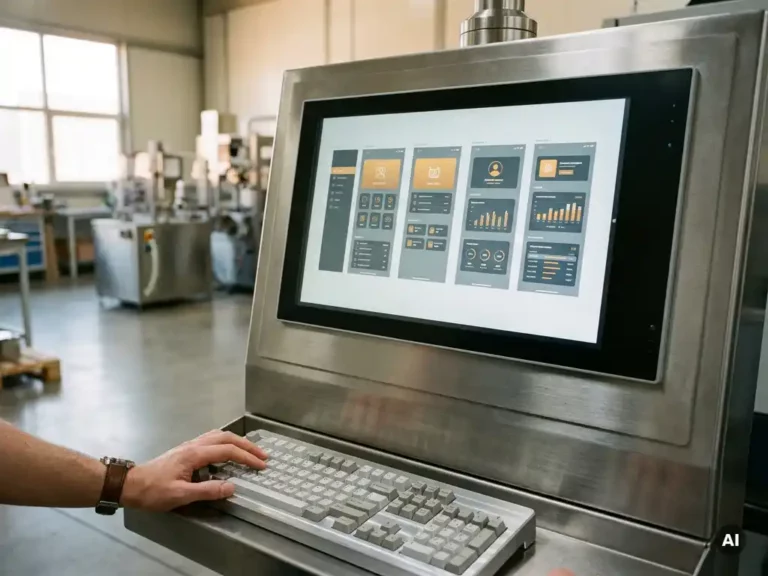
Usability is the measure of how effectively, efficiently, and satisfactorily a person can use a product to achieve a specific goal. In the context of industrial equipment, it determines whether operators can perform their tasks safely, accurately, and without unnecessary cognitive or physical strain. The sections below explore why usability matters, how it connects to safety and compliance, and how it should be built into the development process from day one.
How does poor usability affect industrial equipment operators?
Poor usability in industrial equipment leads directly to slower task completion, higher error rates, increased operator fatigue, and greater risk of accidents. When controls are ambiguous, displays are cluttered, or workflows are counterintuitive, operators must compensate with extra mental effort, and that cognitive load compounds over a full shift, creating conditions where mistakes become far more likely.
The consequences extend beyond individual errors. Equipment that is difficult to use tends to be used inconsistently across an operator team, which makes quality control harder and training more expensive. New employees take longer to reach competency, and experienced operators often develop informal workarounds that bypass safety mechanisms. Over time, poor equipment usability quietly erodes productivity, inflates maintenance costs, and contributes to staff dissatisfaction and turnover.
In high-stakes environments such as manufacturing floors, logistics hubs, or medical device settings, the stakes are even higher. A misread indicator or a confusing emergency stop sequence can have serious consequences. Investing in user-centred design services early in a project is almost always less costly than correcting usability failures after equipment has been deployed.
What are the core principles of usability in industrial design?
The core principles of usability in industrial design are learnability, efficiency, memorability, error tolerance, and user satisfaction. These five dimensions, originally defined by usability researcher Jakob Nielsen, translate directly into design decisions: how controls are labelled, how feedback is communicated, how errors are prevented or recovered from, and how the overall interaction feels to the person using the equipment.
In practice, applying these principles means:
- Learnability: New operators should be able to understand the primary functions of a machine quickly, without relying entirely on a manual.
- Efficiency: Frequent tasks should require the fewest possible steps and the least physical movement.
- Memorability: Operators who return to a machine after time away should be able to reorient themselves without retraining.
- Error tolerance: The design should make it difficult to trigger a harmful action accidentally, and easy to recover when mistakes do occur.
- Satisfaction: Equipment that feels well designed and responsive encourages confident, consistent use.
Good industrial design usability also accounts for the physical environment: lighting conditions, noise levels, protective gloves, and stress all affect how operators interact with controls and displays. A principle that works in a usability lab must still hold up on a production floor at the end of a ten-hour shift.
How does usability relate to workplace safety and compliance?
Usability and workplace safety are directly linked: equipment that is difficult to use is equipment that is more likely to be misused. Regulatory frameworks in many industries, including the EU Machinery Directive and ISO standards such as ISO 9241 (which governs ergonomics of human-system interaction), explicitly require that equipment be designed with the intended user and use environment in mind. Poor usability can therefore create both a safety risk and a compliance liability.
From a compliance perspective, demonstrating that usability has been systematically considered during development is increasingly expected by regulatory bodies. This includes documenting user research, task analysis, and usability testing as part of the design record. In sectors such as medical devices, this documentation is mandatory under regulations like the EU MDR. In industrial manufacturing, it is becoming best practice even where it is not yet strictly required.
Beyond regulation, there is a practical safety argument. Equipment designed with clear visual hierarchies, unambiguous controls, and well-placed emergency stops reduces the probability of human error in exactly the situations where errors matter most. Usability is not a cosmetic concern, it is a foundational element of safe industrial design.
What is the difference between usability and ergonomics in equipment design?
Usability focuses on how effectively and intuitively a person can interact with a system to complete a task, while ergonomics focuses on how well the physical design of a product fits the human body. Both are concerned with the operator’s experience, but they address different dimensions: usability is primarily cognitive and interaction-based, while ergonomics is primarily physical and biomechanical.
In industrial equipment design, the two disciplines overlap significantly and should be addressed together. A machine can be ergonomically well designed, with handles at the right height, controls within comfortable reach, and minimal repetitive strain, yet still have poor usability if its interface is confusing or its feedback mechanisms are inadequate. Conversely, a highly intuitive control system loses much of its value if the operator must adopt an uncomfortable posture to use it.
The most effective approach treats usability and ergonomics as complementary layers of the same design challenge. Physical comfort reduces fatigue, which in turn supports better cognitive performance and more reliable interaction with the equipment’s interface. Designing for one without considering the other leaves the operator experience incomplete.
How do manufacturers test usability in industrial equipment?
Manufacturers test usability in industrial equipment through a combination of expert reviews, task-based user testing, and contextual observation in real or simulated work environments. The goal is to identify points where operators struggle, make errors, or slow down, and to gather that evidence before the equipment reaches production.
Expert reviews and heuristic evaluation
A usability expert reviews the equipment or its prototype against established usability principles, identifying likely problem areas without requiring end users. This is a cost-effective early-stage method that can surface obvious issues quickly. It works best when combined with real user testing rather than used as a substitute for it.
Task-based user testing
Representative users are asked to complete realistic tasks using the equipment while observers note where they hesitate, make errors, or express confusion. Think-aloud protocols, where participants narrate their thought process, add qualitative depth to the findings. In industrial contexts, testing should ideally take place in conditions that reflect the actual work environment, including relevant distractions, time pressure, and protective equipment such as gloves.
Additional methods include eye-tracking to understand where operators look during complex tasks, A/B testing of alternative interface designs, and longitudinal observation to capture how usability changes as operators gain experience. The combination of methods chosen depends on the stage of development, the complexity of the equipment, and the regulatory context.
When should usability be addressed in the equipment development process?
Usability should be addressed from the very beginning of the equipment development process, ideally during the initial concept and requirements phase. Integrating usability considerations early, rather than retrofitting them after engineering decisions have been made, is significantly more effective and less expensive. Changes to an interface concept cost far less than changes to a finished prototype or a deployed product.
A practical timeline looks like this:
- Discovery phase: Conduct user research to understand who will operate the equipment, in what conditions, and what tasks they need to perform. This informs all subsequent design decisions.
- Concept phase: Evaluate early concepts against usability principles and test rough prototypes or mock-ups with representative users.
- Development phase: Conduct iterative usability testing as the design becomes more detailed, refining the interface based on findings.
- Validation phase: Run formal usability testing to confirm that the final design meets the requirements and, where applicable, satisfies regulatory documentation standards.
- Post-launch: Gather feedback from operators in the field to inform future product generations.
The most common mistake in industrial equipment development is treating usability as a final check rather than a continuous process. When user experience industrial design is embedded throughout the project, the result is equipment that operators can use confidently from day one.
How code2design helps with usability in industrial equipment
At code2design, we approach usability not as a checklist item but as a core dimension of every design project. Our holistic 360° design methodology means we consider the operator’s cognitive and physical experience alongside technical requirements, production constraints, and brand positioning, from the earliest concept stage through to final validation.
When we work on industrial equipment, our process includes:
- In-depth user research to understand real operators in real environments, not idealised assumptions about how equipment will be used
- Iterative prototyping and usability testing at multiple stages of development, so problems are identified and resolved before they become costly to fix
- Interface and interaction design that balances clarity, efficiency, and error tolerance with the physical realities of industrial settings
- Cross-disciplinary collaboration between designers, engineers, and, where relevant, research partners such as the Fraunhofer Institut, to ensure solutions are both user-centred and technically sound
- Documentation support for projects where regulatory compliance requires evidence of a structured usability process
With over 75 international design awards and more than 25 years of experience across product and industrial design, we bring both the strategic perspective and the hands-on craft to make usability a genuine competitive advantage for your equipment. If you are developing a new product or reassessing an existing one, we would welcome the conversation. Get in touch with us to discuss how we can help.