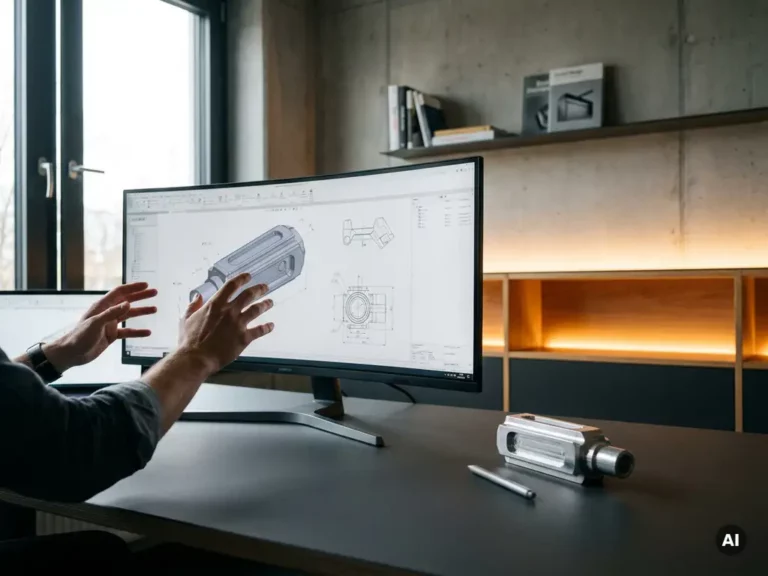
The future of UX in industrial design is human-centered, data-informed, and deeply integrated across the entire product development lifecycle. UX is no longer a finishing layer applied to a product before launch. It is becoming the strategic foundation from which physical products are conceived, tested, and refined. The questions below unpack exactly how this shift is playing out across industries, technologies, and design disciplines.
How is UX changing the way industrial products are developed?
UX is fundamentally restructuring industrial product development by placing user needs at the center of every decision, from early concept work through to production. Rather than treating usability as a late-stage consideration, teams now integrate user research, prototyping, and iterative testing throughout the entire development process. This shift shortens costly redesign cycles and produces products that feel intuitive from the first interaction.
Practically, this means industrial designers are working alongside UX researchers and behavioral specialists far earlier than before. Ethnographic research, usability testing with physical prototypes, and journey mapping are now standard tools in product development, not just in digital product studios. The result is that user experience product design now directly informs decisions about form, material, control placement, and feedback mechanisms in physical goods.
This integration also changes how success is measured. Products are evaluated not just on technical performance or manufacturing efficiency, but on how well they serve real people in real contexts. That standard is raising the bar for what counts as good industrial design.
What role does AI play in the future of UX and industrial design?
AI is accelerating UX-driven industrial design by enabling faster iteration, deeper user insight, and more personalized product experiences. In 2026, AI tools are already being used to simulate user interactions with product interfaces, predict usability issues before physical prototypes are built, and analyze large volumes of user feedback to surface patterns that inform design decisions.
On the research side, AI makes it possible to process behavioral data at a scale that was previously impractical. Designers can identify how different user groups interact with a product concept, then adapt form and interface accordingly. On the generative side, AI-assisted design tools allow teams to explore a far wider range of concepts in less time, freeing designers to focus on judgment and refinement rather than repetitive drafting.
That said, AI does not replace the human insight at the core of good UX. Understanding what a user truly needs, what frustrates them, and what delights them still requires empathy and contextual thinking that no algorithm fully replicates. AI is best understood as a powerful accelerant for human-centered design, not a substitute for it.
How does UX design apply to physical products, not just digital interfaces?
UX design applies to physical products through the full sensory and behavioral experience a person has when using an object. This includes how a product feels in the hand, how intuitively its controls are arranged, how clearly it communicates its state through sound or haptic feedback, and how effortlessly it fits into a user’s daily workflow. Every touchpoint between a person and a physical product is a UX decision.
For industrial products specifically, UX considerations include ergonomics, cognitive load during operation, maintenance accessibility, and the emotional response triggered by materials and finish. A medical device that is technically precise but confusing to operate in a clinical setting has failed at UX. A power tool that is powerful but exhausting to hold for extended periods has the same problem.
The methods used in digital UX, such as persona development, task analysis, and usability testing, translate directly into physical product design. The difference is that physical products require additional consideration of three-dimensional space, tactile sensation, and the environments in which they will actually be used. Industrial design innovation increasingly depends on applying these methods rigorously to hardware, not just software.
What’s the difference between UX design and industrial design?
The key distinction is scope and origin. Industrial design is concerned with the form, function, manufacturability, and material reality of physical objects. UX design is concerned with the quality of a person’s experience when interacting with a product or system, whether physical or digital. In practice, the two disciplines are becoming increasingly interdependent.
What industrial design focuses on
Industrial design addresses the physical and aesthetic dimensions of a product: its shape, structure, materials, production feasibility, and visual identity. An industrial designer considers how a product will be manufactured at scale, how it will perform under real-world conditions, and how it will communicate brand values through its appearance.
What UX design focuses on
UX design focuses on the human side of that same product: how easily someone can learn to use it, how satisfying the interaction feels, and whether the product actually solves the problem it was designed to solve. A UX designer is primarily concerned with the user’s mental model, their goals, and the friction points that prevent them from achieving those goals.
In modern product studios, these disciplines are not siloed. The most effective teams integrate both perspectives from the start, ensuring that a product is both beautifully made and genuinely easy and rewarding to use. Human-centered design, at its best, is what happens when industrial design and UX design operate as a unified practice.
How is sustainability shaping UX decisions in product design?
Sustainability is reshaping UX decisions by expanding the definition of a good user experience to include environmental impact, product longevity, and end-of-life behavior. Designers are increasingly asked to create products that users can repair, upgrade, and responsibly dispose of, and that means UX decisions must support those behaviors explicitly.
This shows up in concrete ways. Repairability requires that UX designers think about how a user accesses internal components, how instructions are communicated, and how error states guide users toward maintenance rather than replacement. Longevity requires that interfaces and controls remain intuitive over years of use, not just at first unboxing. Material transparency, where users can understand what a product is made of and why, is also emerging as a UX consideration in its own right.
Sustainability also influences the emotional dimension of UX. Products designed to last, and that feel built to last, generate a different kind of user relationship than disposable goods. That sense of durability and trustworthiness is itself a UX outcome, and one that forward-thinking designers are actively designing toward.
Which industries will be most transformed by UX-driven industrial design?
The industries most transformed by UX-driven industrial design are those where complex products are used by non-specialist users under demanding conditions. Healthcare, industrial manufacturing, mobility, and consumer electronics are all experiencing significant change as UX thinking moves from the screen to the device itself.
In healthcare, the stakes are highest. Medical devices that are difficult to operate correctly create real risk. UX-driven design in this sector focuses on reducing cognitive load for clinicians and making devices more accessible for patients managing their own care at home. In industrial manufacturing, equipment that workers interact with for long shifts must be designed around human ergonomics and fatigue, not just mechanical capability.
Mobility is another sector undergoing rapid transformation. As vehicles incorporate more digital interfaces and autonomous features, the boundary between industrial design and UX design in automotive and transport products is dissolving. Consumer electronics, smart home devices, and wearables are similarly pushing designers to think about physical and digital experience as a single continuous journey rather than two separate domains.
How code2design helps with UX-driven industrial design
We bring over 25 years of experience integrating user experience thinking into physical product development. At code2design, our holistic 360° design approach means we do not treat UX as a separate phase or an afterthought. We build it into every stage of the product development process, from initial user research and concept development through to detailed design and production preparation.
Here is what working with us looks like in practice:
- Deep user research: We invest in understanding the real people who will use a product, including their environments, habits, frustrations, and goals, before a single concept is drawn.
- Integrated design process: Our interdisciplinary team combines industrial design expertise with UX methods, ensuring that form, function, and user experience are developed together rather than in sequence.
- Strategic market perspective: We connect user insights to brand positioning and market opportunity, so the products we develop do not just work well but also strengthen the businesses behind them.
- Award-winning outcomes: With over 75 international design awards, our track record reflects a consistent commitment to design that is both technically excellent and genuinely human-centered.
Whether you are developing a new product from scratch or rethinking an existing one, we are ready to help you make UX a competitive advantage. Get in touch with our team to start the conversation.