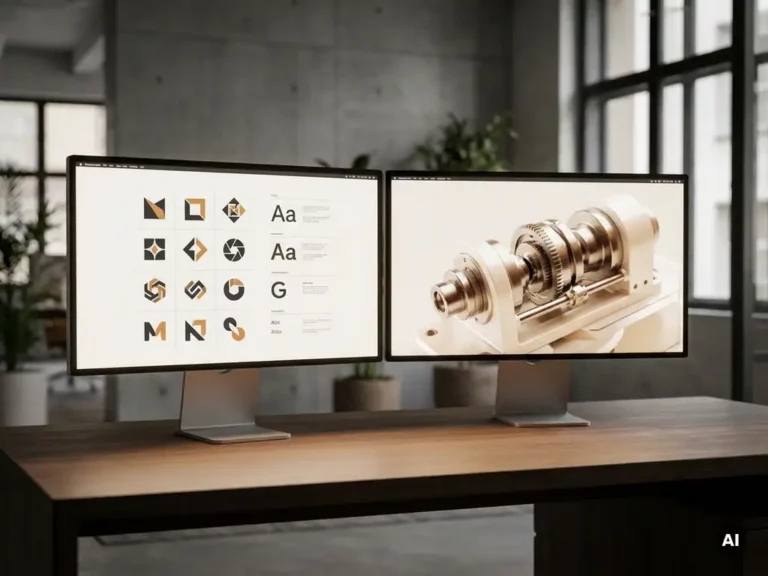
Many companies invest heavily in how their brand looks and feels, yet struggle to explain why their products don’t seem to reflect that same identity. The disconnect often traces back to a fundamental confusion between two closely related but distinct disciplines: corporate design and corporate industrial design. Understanding the difference is not just an academic exercise. For product-driven businesses, it shapes how customers perceive value, build trust, and ultimately decide to buy.
Both disciplines serve brand identity, but they operate in different dimensions. One governs how a brand communicates visually across every touchpoint. The other ensures that the physical products a company brings to market carry that same identity into the real, three-dimensional world. Getting both right, and getting them to work together, is one of the most powerful levers a company has for sustainable market success.
How corporate design shapes brand identity beyond visuals
Corporate design is the systematic framework that defines how a brand presents itself consistently across all communications and environments. It goes well beyond a logo or a color palette. At its core, it establishes the visual language a company uses to signal who it is, what it stands for, and why it deserves attention in a crowded market.
This framework typically includes typography, iconography, imagery styles, layout principles, and the tone of visual communication across print, digital, and physical spaces. When executed well, corporate design creates instant recognition. Think of the way a consistent brand system makes a company feel trustworthy and coherent, whether a customer encounters it on a website, a trade show booth, or a product catalog. The visual system becomes a promise, and every touchpoint either reinforces or erodes that promise.
The strategic depth of corporate design is often underestimated. Strong brand identity built through design reduces customer decision-making friction, supports premium pricing, and builds the kind of emotional resonance that turns buyers into loyal advocates. It is a long-term asset, not a cosmetic layer.
What corporate industrial design adds to the equation
Corporate industrial design takes the principles of brand identity and translates them into physical form. Where corporate design governs how a brand looks on a screen or a page, industrial design determines how a product feels in the hand, how it communicates quality through its materials, how its proportions signal confidence or precision or approachability.
This discipline combines engineering knowledge, ergonomics, materials science, and aesthetic sensibility to create products that function excellently and feel unmistakably right. A well-designed product does not just solve a problem. It communicates brand values without words. The weight of a medical device, the texture of a handle, the way a lid closes on a consumer appliance: all of these details speak directly to a user’s emotional experience and perception of quality.
Corporate industrial design also encompasses the full development journey, from early concept sketches and user research through prototyping, engineering collaboration, and preparation for series production. This breadth means that design services in this field are genuinely strategic, not purely aesthetic. They influence manufacturing costs, time-to-market, and long-term product portfolio coherence.
Where the two disciplines overlap and diverge
The overlap between corporate design and corporate industrial design is real and significant. Both disciplines are grounded in brand strategy. Both aim to create consistent, emotionally resonant experiences for the people who encounter a company’s output. Both require deep understanding of the target audience and the competitive landscape.
Where they diverge is in their medium and methodology. Corporate design works primarily in two dimensions, with tools rooted in graphic communication, digital experience, and visual systems thinking. Corporate industrial design works in three dimensions, with tools rooted in form development, material behavior, manufacturing constraints, and physical user interaction.
The risk for companies is treating these as entirely separate workstreams. When the visual brand team and the product development team operate in silos, the result is often a mismatch. A brand that communicates innovation and precision through its marketing may produce products that feel generic or inconsistent with that promise. Alignment between the two disciplines is not optional for companies that want to build genuine brand equity through their product portfolio.
Why product-driven companies need both working together
For companies whose primary market touchpoint is a physical product, the integration of corporate design and corporate industrial design is a competitive necessity. The product is not just a deliverable. It is the most powerful brand communication tool a company has, because it lives in the customer’s environment every day.
When both disciplines are aligned, something powerful happens. Products begin to carry the brand story in a tangible, lasting way. A sensor technology company that has invested in a coherent visual identity but whose hardware looks generic misses the opportunity to make its brand felt at the moment of use. Conversely, a company with beautifully engineered products that lack visual brand coherence struggles to build recognition and premium positioning in the market.
The business case for integration goes beyond aesthetics. Consistent design across visual and product dimensions shortens the time customers need to build trust. It supports clearer product portfolio architecture. It reduces the cost of rebranding exercises down the line, because the brand language is embedded in the product DNA from the start. Industry experience consistently shows that companies treating design strategy holistically achieve stronger market differentiation and more resilient brand equity over time.
How to choose the right design partner for both
Choosing a design partner capable of bridging corporate design and corporate industrial design requires looking beyond a strong portfolio. The right partner understands brand strategy as the foundation of every design decision, not as a brief to be handed over and filed away.
Look for a partner who asks about your brand positioning before talking about form and color. The best industrial design studios approach each project by developing deep user insights and market understanding first, then translating those insights into products that genuinely reflect your brand identity. This holistic approach ensures that the resulting products do not just function well. They tell a coherent story.
Practical criteria worth evaluating include:
- Experience across the full development cycle, from strategy and concept through engineering and production readiness
- The ability to work across different industries and product categories without losing brand specificity
- A track record of award-winning work that demonstrates both aesthetic and functional excellence
- A collaborative working model that integrates with your internal teams rather than replacing them
- Transparency about process, timelines, and how design decisions connect back to business objectives
The size of the studio also matters. Smaller, senior-led studios often provide the strategic depth and direct partner involvement that large-scale product decisions require, without the overhead of agency bureaucracy.
How code2design bridges corporate design and corporate industrial design
At code2design, we work at exactly this intersection. Our Stuttgart-based studio has spent over 25 years helping product-driven companies translate their brand identity into physical products that perform, resonate, and endure in the market. Our 360° design approach means we never treat visual brand language and product form as separate conversations. We bring them together from the very first brief.
Here is what working with us looks like in practice:
- Strategic brand and product alignment: We begin every project by understanding your brand positioning, your target users, and your competitive landscape before a single sketch is drawn.
- Full-service product development: From concept ideation and user research through detailed engineering, interface design, and production preparation, we cover every phase.
- Portfolio coherence: We help companies build product families that are visually and functionally consistent, strengthening brand recognition across every touchpoint.
- Award-winning design expertise: With over 75 international design awards, our work demonstrates that functional excellence and emotional impact are not trade-offs.
- Senior-led collaboration: Founder Michael Schmidt leads every project personally, ensuring that strategic depth and design quality are never delegated away.
If your company is ready to close the gap between how your brand communicates and how your products feel, we would love to talk. Get in touch with us to start the conversation.