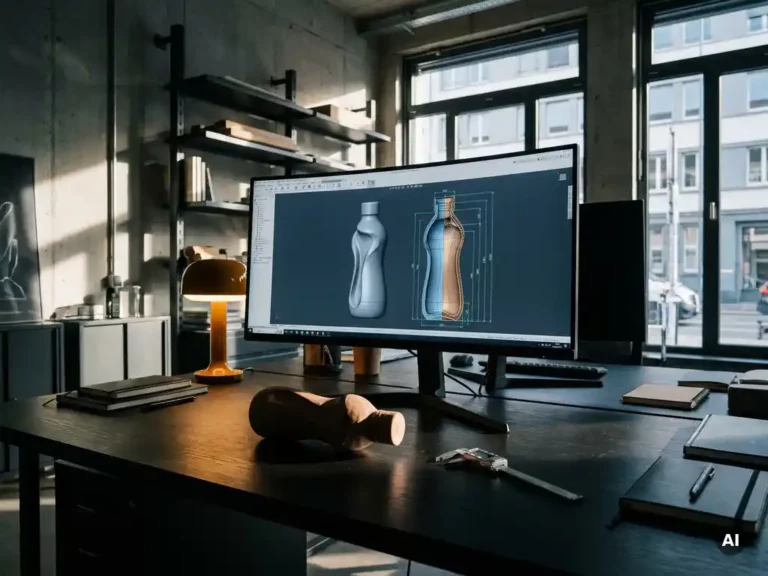
Product development rarely runs in a straight line. When industrial designers and engineers work toward the same goal, friction is almost inevitable. Designers push for forms that feel intuitive and emotionallyly resonant. Engineers push back with material constraints, load tolerances, and manufacturing realities. Neither side is wrong. But without a clear process for resolving those tensions, the conflict can slow development, dilute the product vision, or produce compromises that satisfy no one.
Understanding how to manage the gap between design and technical requirements is one of the most practical skills in the industrial design process. The teams that do it well don’t eliminate disagreement. They build structures that make disagreement productive.
Where design and engineering goals typically diverge
The divergence usually starts at the same place: different definitions of success. A designer measures success by how well a product communicates its purpose, fits the hand, and earns trust from the person using it. An engineer measures it by whether the product holds together, meets safety standards, and can be manufactured at a reasonable cost. Both definitions are valid. The problem is that optimizing for one can actively undermine the other.
Common flashpoints include wall thickness, material selection, surface finish, and assembly sequence. A designer may specify a radius that looks elegant but creates a stress concentration the engineer cannot accept. An engineer may propose a fastening method that works structurally but breaks the visual language of the product. These aren’t failures of communication so much as they are natural consequences of two disciplines trained to see different things in the same object.
How shared language bridges the gap early
One of the most effective ways to reduce conflict in design-engineering collaboration is to establish shared vocabulary before the project starts. When both disciplines agree on what terms like „tolerance,“ „finish quality,“ or „user-critical surface“ mean in the context of a specific product, misreadings become far less common.
Early co-creation sessions where designers and engineers sketch together, review references together, and define constraints together tend to produce fewer late-stage conflicts. When an engineer understands the reasoning behind a design decision, and a designer understands the physical limits of a given process, both sides can make better-informed trade-offs from the start. This isn’t about removing specialization. It’s about building enough shared context that each discipline can anticipate the other’s concerns before they escalate.
Structured methods for resolving design-engineering conflicts
When disagreements do arise, having a structured resolution method prevents them from becoming personal or political. Several approaches have proven effective across different types of product development.
Prototype-based arbitration
Building a physical or digital prototype of the contested feature is often the fastest way to resolve a dispute. Abstract arguments about what will or won’t work tend to dissolve when both sides can look at a tangible object. Rapid prototyping allows teams to test the design intent against engineering constraints in real time, making the conversation factual rather than theoretical.
Constraint mapping
Constraint mapping involves listing every requirement, both design and technical, and categorizing each one as fixed, flexible, or negotiable. Fixed constraints are non-negotiable. Flexible ones can shift within a defined range. Negotiable constraints are open for trade-offs. This method gives both sides a shared view of the solution space and makes it easier to identify where creative compromise is genuinely possible.
Decision logs
Documenting every significant design-engineering decision, including what was decided, why, and who was involved, creates accountability and prevents the same argument from resurfacing. Decision logs are especially valuable in longer projects where team members change or memory of early trade-offs fades.
When to compromise and when to push back
Not every conflict deserves a compromise. Some design decisions are load-bearing in the same way that structural elements are. If a feature defines the user experience or communicates something essential about the brand, diluting it to satisfy a constraint that hasn’t been fully explored is a poor trade.
The key question is whether the constraint is genuinely fixed or whether it reflects a default assumption. Engineers sometimes apply conservative standards from previous projects that don’t apply to the current one. Designers sometimes hold onto aesthetic choices that have no functional justification. Pushing back is appropriate when the constraint hasn’t been tested. Compromise is appropriate when the constraint is real and the design intent can be preserved through an alternative approach. The discipline is in knowing which situation you’re in.
This is also where exploring the full range of design and engineering services available to a project can open up options that neither side considered independently.
The role of leadership in sustaining design-engineering alignment
Alignment between design and engineering doesn’t sustain itself. It requires active support from project leadership and, in many cases, from the broader organization. When leadership treats design and engineering as sequential rather than parallel disciplines, conflict becomes structural. Designers hand off work. Engineers push back. Designers revise under pressure. The result is a product shaped more by iteration fatigue than by clear intent.
Leaders who sustain alignment tend to do a few things consistently. They create space for joint reviews early in the process, not just at handoff points. They treat unresolved conflicts as project risks, not just interpersonal issues. And they hold both disciplines accountable to the same product vision rather than to their own departmental metrics. When the goal is shared, the conversation changes.
How code2design helps bridge design and engineering
At code2design, we have spent more than 25 years working at exactly this intersection. Our holistic 360° design approach means that design intent and technical feasibility are considered together from the first brief, not reconciled at the end of the process. Here is what that looks like in practice:
- Integrated project teams where designers and technical specialists work in parallel from the earliest concept phase
- Structured constraint reviews that surface engineering limitations before they become design blockers
- Prototype-driven decision making that keeps debates grounded in what can actually be built
- Clear documentation of every major trade-off, so decisions are traceable and revisitable
- Strategic alignment with your brand identity, so no technical compromise erodes what the product needs to communicate
With over 75 international design awards and deep experience across sectors from medical technology to industrial equipment, we know how to move a product from vision to production without losing what made the original idea compelling. If your team is navigating the tension between design ambition and technical reality, get in touch with us and let’s find the right path forward together.