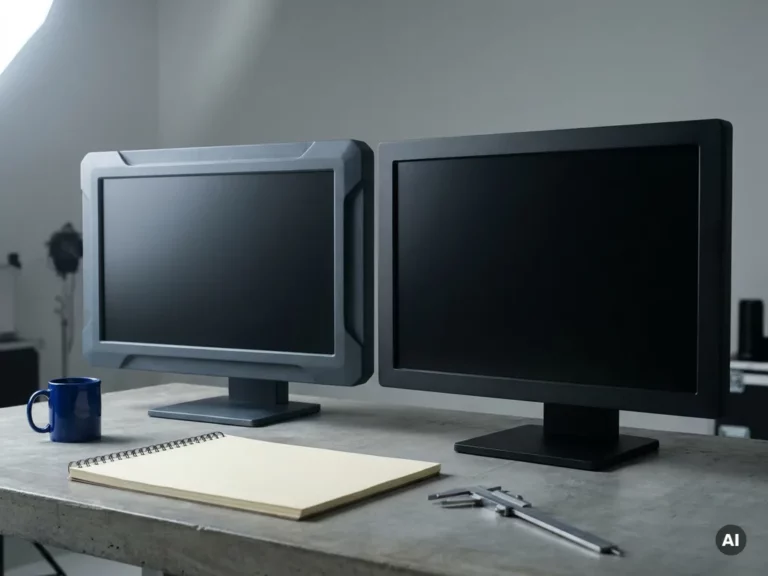
When two products perform the same function, meet the same specifications, and hit the same price point, what actually drives a B2B buyer to choose one over the other? Technical parity is increasingly common across industries, from sensor technology to medical devices to industrial machinery. In these markets, industrial design has quietly become one of the most powerful levers for differentiation, shaping perception, building trust, and ultimately influencing purchasing decisions long before a sales conversation begins.
This matters especially for B2B products, where buyers are often assumed to be purely rational actors focused on specs and price. In reality, product managers and procurement teams are human. They respond to clarity, confidence, and quality signals, all of which can be communicated through B2B product differentiation rooted in thoughtful design strategy.
Where technical parity leaves B2B buyers undecided
Technical parity creates a genuine decision-making vacuum. When competing products are functionally equivalent, buyers default to proxies for quality, and physical product design is one of the most immediate and credible signals available. A product that looks precise, considered, and well-crafted communicates competence before a single data sheet is read.
This effect is amplified in B2B contexts because purchasing decisions often involve multiple stakeholders with different priorities. An engineer evaluates specifications, but a business unit manager evaluates confidence. A procurement officer weighs total cost of ownership, but a company director weighs brand alignment. Industrial design speaks to all of these audiences simultaneously, giving a product a presence that purely technical arguments cannot replicate.
How industrial design shapes perceived product value
Perceived value is not a soft concept. It directly affects willingness to pay, customer retention, and the ease with which a sales team can close deals. When a product is designed with intentionality, from ergonomics and material choices to surface finish and visual hierarchy, it communicates quality in ways that specifications alone cannot.
In technically similar product categories, design differentiation works on two levels. At the functional level, good design reduces friction: better grip, clearer controls, more intuitive interfaces. At the emotional level, it creates a sense of reliability and premium positioning. Both levels contribute to a buyer’s confidence that they are making the right choice, which is exactly the reassurance a B2B purchaser needs when justifying a decision internally.
Design as a carrier of brand identity in physical products
A physical product is one of the most tangible expressions of a brand that a company can put into the world. Every time a customer interacts with it, they are forming an impression of the company behind it. This makes product design strategy inseparable from brand strategy, particularly in B2B markets where trust and long-term relationships are central to commercial success.
Design can encode brand values into form. A company that positions itself around precision engineering should have products that feel precise in the hand. A brand built on innovation should present products that look forward-looking, not derivative. When the design language of a product aligns with the brand promise, it reinforces credibility at every touchpoint. Conversely, a mismatch between brand positioning and product appearance creates cognitive dissonance that erodes trust, even if the product performs flawlessly.
This is why the most effective product development services treat design not as a finishing step but as a strategic instrument that translates brand identity into three-dimensional reality.
Turning user insights into competitive product advantages
Differentiation through design is most durable when it is grounded in genuine user understanding. Surface-level styling can be copied quickly by competitors. But design that solves real problems, reduces real friction, and reflects real workflows is much harder to replicate, because it requires deep knowledge of how the product is actually used.
Gathering those insights requires structured research: observing users in context, mapping workflows, identifying pain points that users themselves may not articulate directly. This kind of ethnographic approach to product development reveals opportunities that purely technical product development misses entirely. A handle positioned differently, a display angled for a specific working posture, a connection interface designed for gloved hands: these details feel minor in isolation but collectively define a product experience that competitors cannot simply reverse-engineer from the outside.
When B2B industrial design work is driven by this kind of user research, the resulting products do not just look different. They work better for the specific people who use them, which creates loyalty that price competition alone cannot undermine.
Measuring the business impact of design differentiation
Design investment is sometimes treated as difficult to quantify, but the business outcomes of effective design differentiation are measurable across several dimensions. Premium pricing is the most direct: products with strong design positioning consistently command higher margins than technically equivalent alternatives, because buyers perceive and are willing to pay for the difference in quality and confidence.
Beyond pricing, design differentiation affects sales cycle length. Products that communicate their value clearly and credibly through their appearance require less explanation and fewer demonstrations to reach a purchasing decision. They also reduce the burden on sales teams, who spend less time overcoming skepticism and more time building relationships.
Customer retention is another measurable outcome. When users enjoy interacting with a product and associate it with a positive brand experience, they are more likely to return for repeat purchases and less likely to switch when a competitor offers a marginally lower price. Over a product lifecycle, this loyalty compounds into significant commercial value. For companies serious about long-term market positioning, design is not an expense but a strategic investment with a trackable return.
How code2design helps with B2B product differentiation through industrial design
At code2design, we work with product managers and business leaders who understand that technical excellence alone is no longer enough to win in competitive markets. Our holistic 360° design approach connects deep user research, brand strategy, and technical expertise into a single integrated process, ensuring that every design decision serves both the user and the business.
- Strategic design positioning: We help companies identify where design can create the most meaningful differentiation within their specific market and competitive context.
- User research and insight translation: We go beyond assumptions, conducting structured research to uncover the real behaviors and needs that should drive product decisions.
- Brand-aligned product language: We develop design languages that make brand identity tangible and consistent across an entire product portfolio.
- Full-service development: From concept through to production-ready design, including interface design, we support the entire product development journey.
- Proven track record: With over 75 international design awards, we bring recognized expertise to every project, regardless of industry or product complexity.
If your products are technically strong but struggling to stand out in a crowded market, we would be glad to explore how design strategy can change that. Get in touch with us to start the conversation.