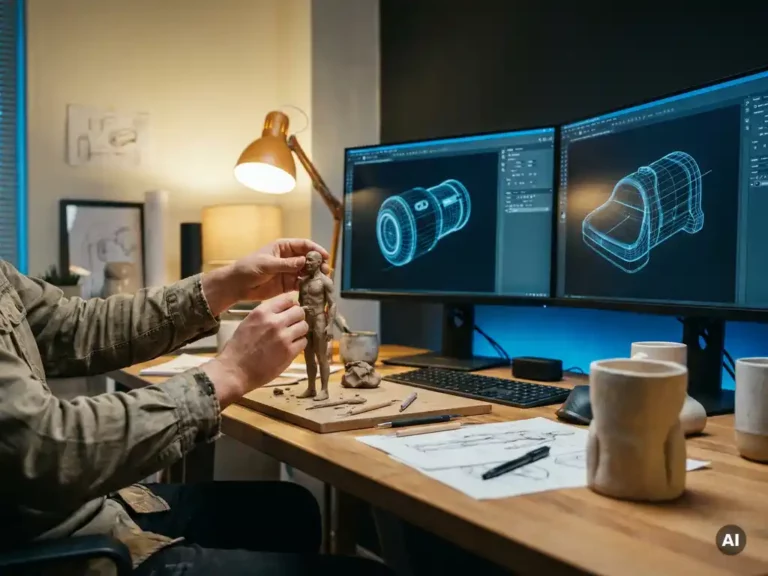
Human-centered design (HCD) is a problem-solving approach that puts the real needs, behaviors, and frustrations of end users at the heart of every product decision. Rather than designing around technical constraints or internal assumptions, HCD starts with people and works outward. It matters for B2B products because the people who use those products every day are just as human as any consumer, and designing for them drives adoption, reduces errors, and creates measurable business value.
In B2B contexts, the stakes are especially high. A poorly designed industrial tool or enterprise software interface does not just frustrate users; it slows workflows, increases training costs, and can undermine an entire procurement decision. The questions below unpack how HCD works, why it is uniquely challenging in B2B, and when it makes the most sense to invest in it.
How does human-centered design actually work in practice?
Human-centered design works by cycling through four core activities: understanding users through research, defining the real problem, generating and testing solutions, and iterating based on feedback. The process is not linear, teams move back and forth between stages as they learn more about the people they are designing for. The goal is to replace assumptions with evidence at every step.
In practice, this looks like ethnographic field research, contextual interviews, usability testing, and rapid prototyping. A design team might spend time on a factory floor watching operators interact with equipment before sketching a single concept. They observe what workarounds people have invented, what causes hesitation, and what tasks consume disproportionate effort.
From those insights, designers define a problem statement rooted in actual user needs rather than product specifications. Concepts are then developed and placed in front of real users early, often as rough prototypes, so feedback can reshape the direction before significant engineering investment has been made. This iterative loop is what separates HCD from traditional design processes that only validate a finished product at the end.
The approach applies equally to physical product design and digital interfaces. Whether the outcome is an industrial device, a control panel, or a B2B product development project spanning hardware and software, the underlying method stays the same: understand people deeply, test ideas early, and keep refining.
Why is human-centered design harder to apply in B2B than in consumer products?
Human-centered design is harder in B2B because there is rarely a single user. B2B products serve multiple stakeholders simultaneously: the person who operates the product, the manager who oversees the workflow, the procurement team that approves the purchase, and the IT department that maintains it. Each group has different needs, priorities, and definitions of success, and designing for all of them at once is genuinely complex.
Access to users is also more difficult. Consumer designers can recruit participants relatively easily. In B2B, reaching the actual end users often requires navigating corporate gatekeepers, signing NDAs, and working around shift schedules or safety restrictions. This makes user research slower and more resource-intensive.
There is also a tension between usability and compliance. Many B2B products operate in regulated industries where safety standards, certification requirements, and legacy system compatibility constrain design freedom significantly. A design that would be ideal for the user may conflict with an existing infrastructure or regulatory requirement, forcing careful trade-offs.
Finally, B2B purchasing decisions are rarely made by the people who will actually use the product. The buyer and the user are often different people with different priorities, which means the product must satisfy both a purchasing committee looking at ROI and an operator looking for ease of use. Balancing those two audiences is one of the defining challenges of B2B UX.
What business outcomes does human-centered design drive for B2B companies?
Human-centered design drives measurable business outcomes including faster user adoption, lower training costs, reduced support burden, and stronger competitive differentiation. When a B2B product fits naturally into how people actually work, it gets used correctly from day one rather than being resisted, worked around, or abandoned after deployment.
Adoption speed matters enormously in B2B. A product that requires weeks of training before users become productive creates real costs for the buyer. A well-designed product that aligns with existing mental models and workflows reduces that ramp-up time significantly, which becomes a genuine selling point during the procurement process.
HCD also reduces costly errors. In industrial and professional environments, interface confusion or unintuitive controls can lead to mistakes that have safety, financial, or reputational consequences. Designing for clarity and appropriate feedback mechanisms reduces error rates, which is a quantifiable benefit that B2B buyers care about deeply.
From a market positioning perspective, human-centered design creates products that tell a compelling story. When users feel that a product was built with their reality in mind, they become advocates. That word-of-mouth credibility is particularly powerful in B2B markets where purchasing decisions rely heavily on peer recommendations and industry reputation.
Who should be involved in a human-centered design process for B2B products?
A human-centered design process for B2B products should involve end users, product managers, engineers, and design specialists working together from the research phase onward. Waiting until late in the development cycle to involve any of these groups creates handoff problems and missed insights that are expensive to correct.
End users are the most critical voice. This means the actual operators, technicians, or professionals who will interact with the product daily, not just the managers who oversee them. Their direct input during research and testing phases shapes decisions that no amount of internal discussion can replicate.
Engineers need to be present during design exploration, not just during implementation. When technical constraints are surfaced early, designers can work within them creatively rather than delivering concepts that are impractical to build. This collaboration prevents the frustrating dynamic where a promising design gets stripped down during engineering handoff.
Product managers bring market context and prioritization judgment. They help the team distinguish between user desires that align with business strategy and those that fall outside the product’s scope. In B2B, where product roadmaps often span years, this strategic filter is essential.
Depending on the project, the team may also benefit from involving procurement stakeholders, regulatory specialists, or distribution partners who understand the full lifecycle of the product from sale to service.
When should B2B companies invest in human-centered design?
B2B companies should invest in human-centered design when they are developing a new product category, redesigning an existing product that is underperforming in adoption or user satisfaction, or entering a market where they lack deep knowledge of how end users actually work. These are the moments when the cost of getting it wrong is highest and the return on research investment is clearest.
New product development is the most obvious entry point. Starting with user research before committing to a technical direction means the product is built on validated needs rather than internal assumptions. This reduces the risk of launching something that misses the mark and requires expensive iteration after release.
Redesign projects are equally important. If a product has high churn, frequent support calls, or poor adoption rates, those are signals that something in the user experience is broken. HCD provides the diagnostic tools to identify the root cause and the creative process to address it systematically rather than through guesswork.
Companies entering unfamiliar markets, whether through geographic expansion or moving into a new industry vertical, also benefit significantly from HCD. The assumptions that worked in one context often do not transfer. Investing in user research before scaling protects against costly missteps and builds the local knowledge needed to compete effectively.
In 2026, with increasing complexity in both physical products and the digital interfaces that control them, the window for launching a product that ignores user experience is narrowing. B2B buyers are more sophisticated, and their expectations for product usability are rising to match what they experience as consumers.
How code2design approaches human-centered design for B2B products
We bring over 25 years of experience applying human-centered design principles to complex B2B and industrial products. Our 360° design approach integrates deep user research with technical expertise and strategic market thinking, so the products we develop do not just function well, they create genuine emotional value and strengthen the brands behind them.
Working with us on a B2B product design project means:
- User research embedded from day one, including field observation and stakeholder interviews to surface the real needs behind the brief
- Interdisciplinary collaboration between our senior designers, external specialists, and your engineering and product teams throughout the process
- Rapid prototyping and iterative testing to validate concepts before significant development investment is committed
- Strategic design thinking that connects user insights to market positioning and long-term brand value
- Full-service capability from product strategy and concept development through to interface design and production-ready specifications
Our portfolio of over 75 international design awards reflects a consistent commitment to products that perform, inspire, and endure. If you are developing a B2B product and want to build user needs into its foundation rather than retrofit them later, we would love to talk. Reach out to our team to start the conversation.