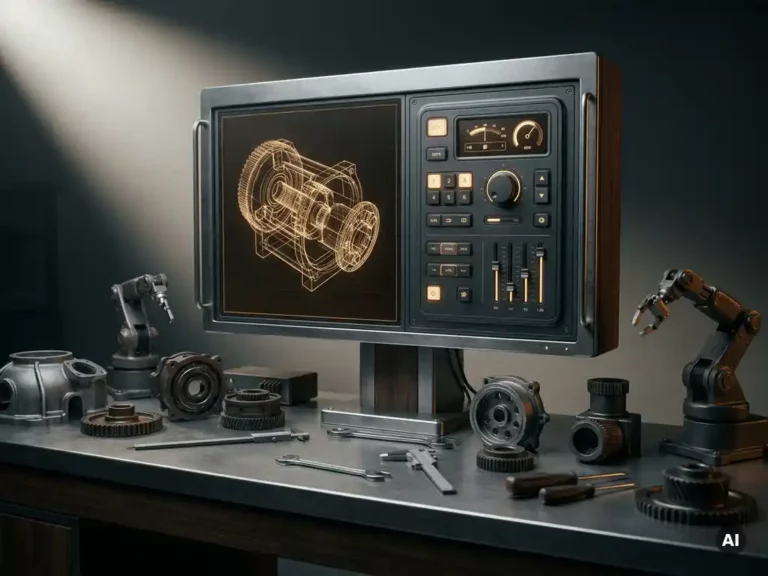
UX design and UI design are distinct disciplines that serve different purposes in industrial product development. UX design, or user experience design, focuses on how a product feels to use: the logic, flow, and overall interaction journey. UI design, or user interface design, focuses on the visual and tactile elements a user directly touches or sees. In industrial products, both must work together, and understanding where each begins and ends is essential for building products that perform and sell.
How do UX and UI design each shape an industrial product?
UX design shapes an industrial product by defining how a user moves through a task, from switching on a machine to completing a complex operation. UI design then gives that journey its physical or digital form, through buttons, displays, indicators, and controls. Together, they determine whether a product feels intuitive or frustrating in real-world use.
In the context of industrial products, UX design often begins with deep research: observing how operators actually use equipment, identifying pain points in workflows, and mapping out the cognitive steps a user takes to complete a task. This research informs decisions about control placement, feedback mechanisms, and error prevention. A well-designed UX means a technician can operate a complex machine with minimal training because the product logic mirrors how people naturally think and act.
UI design in industrial products then translates those structural decisions into tangible form. This includes the layout of a control panel, the hierarchy of information on a digital display, the tactile feedback of a button, or the color coding of status indicators. Good UI design in an industrial context is not about aesthetics alone. It is about clarity, legibility under poor lighting, and reducing the chance of operator error in high-stakes environments.
Where does UX end and UI begin in product development?
UX ends where the structural decisions about interaction are complete, and UI begins when those decisions are given physical or visual form. In practice, UX defines what a user needs to do and in what order, while UI defines what they see, touch, and respond to. The handoff between the two is rarely a hard line, but the distinction in responsibility is clear.
During UX work, the output is typically wireframes, user journey maps, task flows, and interaction logic. These documents answer questions like: How many steps does it take to change a setting? What happens when an error occurs? What information does an operator need first? These outputs do not yet specify color, font, or physical form.
UI design picks up from there, turning those interaction blueprints into a concrete interface. In an industrial product, this might mean designing a touchscreen layout that matches the task flow defined in UX, or specifying the physical dimensions and labeling of a control panel so that the most critical functions are immediately accessible. The best product development processes treat UX and UI as overlapping phases rather than sequential ones, with both disciplines in regular dialogue throughout.
Why do industrial products fail when UX and UI are misaligned?
Industrial products fail when UX and UI are misaligned because the physical interface no longer reflects the intended user journey, creating confusion, errors, and operator frustration. When UI is designed independently of UX research, controls end up in the wrong place, critical information gets buried, and the product becomes harder to use than it needs to be, regardless of how well it functions mechanically.
A common example of misalignment is a machine with a technically capable control system that operators consistently misuse because the interface does not match their mental model of the task. The UX research may have identified that operators think in terms of sequential steps, but if the UI groups controls by technical function rather than task order, the mismatch creates friction every time the machine is used.
In industrial environments, this friction has real consequences. Misaligned UX and UI can lead to:
- Increased operator training time and costs
- Higher rates of user error and safety incidents
- Reduced productivity and longer task completion times
- Negative product reviews and lower customer retention
- Costly redesigns after market launch
The earlier UX and UI are aligned in the development process, the lower the cost of correction. Misalignment caught in prototyping is far cheaper to fix than misalignment discovered after production.
What does a UX designer actually do differently from a UI designer?
A UX designer focuses on understanding user behavior, defining interaction logic, and structuring the overall experience. A UI designer focuses on the visual and physical execution of that structure. In short, a UX designer answers „what should happen and why,“ while a UI designer answers „what does the user see and touch?“
Core UX designer responsibilities in industrial products
A UX designer working on industrial products typically conducts user research with operators and technicians, builds task flow diagrams, creates low-fidelity wireframes, and tests interaction concepts with real users before any visual design begins. Their work is grounded in behavioral insight and ergonomic principles. They ask questions like: What is the user’s goal? What are the risks of error? How does stress or time pressure affect decision-making on the factory floor?
Core UI designer responsibilities in industrial products
A UI designer working on industrial products takes those research-backed structures and gives them form. They specify the layout of displays and control panels, choose typography and color systems that remain legible in industrial environments, design iconography that communicates function at a glance, and ensure visual hierarchy guides the user’s attention to what matters most. Their decisions are grounded in visual communication principles and an understanding of the physical context in which the product will be used.
Both roles require deep knowledge of the industrial context. A UI designer who has never observed how a machine is used in a real production environment will make very different decisions than one who has. This is why holistic product design services that integrate both disciplines from the start tend to produce stronger outcomes.
Should industrial companies hire separate UX and UI designers?
Industrial companies should consider hiring separate UX and UI designers when product complexity is high and the cost of user error is significant. For simpler products or smaller teams, a hybrid designer with strong skills in both areas may be sufficient. The key factor is not job titles but whether both the experience logic and the interface execution receive dedicated, expert attention.
For large-scale industrial products, such as complex machinery, medical devices, or multi-operator control systems, the depth of user research required for effective UX work is substantial. Separating the roles allows each designer to go deeper in their area of expertise. A UX designer can spend weeks in the field observing real operator behavior, while a UI designer focuses on translating those findings into a precise, production-ready interface.
For smaller companies or products with less complexity, a well-rounded designer who understands both disciplines can often cover both areas effectively, particularly when supported by structured design processes and regular user testing. The risk is not in combining the roles, but in skipping either discipline entirely. Many industrial products fail not because they lack a dedicated UX or UI designer, but because neither function was given serious attention during development.
How code2design helps with UX and UI design for industrial products
At code2design, we approach UX and UI design as inseparable parts of a single, holistic product development process. Our 360° design approach means we never treat the interface as an afterthought. We integrate user research, interaction logic, and interface execution from the earliest stages of a project, so that what a product does and how it feels to use are always developed in alignment.
Working with us, industrial companies benefit from:
- Deep user research and field observation to ground UX decisions in real operator behavior
- Interaction design and task flow development that reduces user error and training time
- UI design tailored to industrial environments, including ergonomics, legibility, and safety requirements
- Rapid prototyping and user testing to validate both UX and UI decisions before production
- Over 25 years of experience and more than 75 international design awards across complex product categories
If you are developing an industrial product and want UX and UI design that genuinely improves usability and strengthens your market position, we would love to hear about your project. Get in touch with our team to start the conversation.