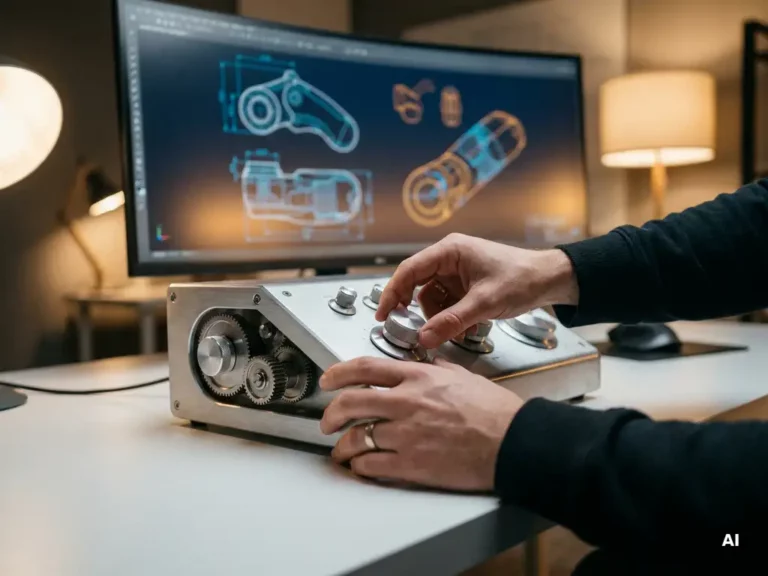
B2B companies need UX design for physical products because it directly shapes how efficiently operators use equipment, how quickly teams adopt new tools, and how confidently procurement managers justify purchases. In industrial and manufacturing contexts, a product that is difficult to use creates measurable operational costs, not just frustration. The questions below unpack exactly how UX design drives value across the B2B product lifecycle.
How does UX design influence purchasing decisions in B2B markets?
UX design influences B2B purchasing decisions by reducing perceived risk. When evaluators interact with a product during a demo or trial, intuitive controls, clear feedback, and logical workflows signal that the product will integrate smoothly into existing operations. A well-designed physical product communicates competence before a contract is signed.
In B2B markets, purchasing decisions involve multiple stakeholders: end users, operations managers, procurement teams, and sometimes safety officers. Each group evaluates the product through a different lens. End users ask whether the product is easy to operate. Managers ask whether it will reduce training time and error rates. Procurement asks whether it will generate support tickets or warranty claims. Strong UX design for physical products addresses all of these concerns simultaneously, making the product easier to champion internally across all decision-making layers.
Unlike consumer markets where emotional appeal can close a sale, B2B buyers must justify their choice with evidence. A product with clear interface logic, well-placed controls, and ergonomic design gives buyers concrete arguments for internal approval. This is why UX is not just a product quality issue in B2B, it is a commercial strategy.
What are the key UX elements in physical B2B products?
The key UX elements in physical B2B products are ergonomics, interface clarity, feedback mechanisms, error prevention, and learnability. Together, these elements determine how quickly a user can operate a product safely and effectively in real working conditions, often under time pressure or in physically demanding environments.
- Ergonomics: Physical controls, grip points, and operating postures must match the actual body mechanics of the user in their specific work context.
- Interface clarity: Labels, indicators, and control hierarchies must communicate function without requiring the user to consult a manual during operation.
- Feedback mechanisms: Tactile, auditory, or visual signals that confirm an action has been registered reduce errors and build operator confidence.
- Error prevention: Physical design choices that make incorrect operation difficult or impossible, such as keyed connectors or guarded switches, are core UX decisions, not just engineering ones.
- Learnability: A product that a new operator can use competently after minimal training reduces onboarding costs and accelerates time-to-productivity.
In industrial design for B2B, these elements must be validated against the actual use environment, not an idealized lab setting. Noise, vibration, gloves, fatigue, and shift-change handovers all affect how a product is used in practice.
How does poor UX affect B2B product adoption and retention?
Poor UX in B2B physical products leads to slower adoption, higher training costs, increased error rates, and ultimately contract churn. When operators find a product difficult or unintuitive, they develop workarounds, avoid certain features, or revert to older tools. Over time, this erodes the perceived value of the product and damages the supplier relationship.
The downstream effects of poor product usability in B2B are often underestimated at the design stage. A device that requires two hours of training instead of twenty minutes multiplies that cost across every new operator over the product’s lifetime. A control panel that causes frequent input errors generates support calls, warranty claims, and, in safety-critical industries, compliance risk.
Retention is equally at stake. B2B contracts are renewed based on demonstrated value. If a product’s usability creates friction rather than removing it, the vendor becomes associated with operational problems rather than operational improvement. Competitors who invest in UX design for manufacturing equipment will consistently win renewal conversations on that basis alone.
What is the difference between industrial design and UX design for B2B products?
Industrial design focuses on the physical form, materials, manufacturing feasibility, and aesthetic language of a product. UX design focuses on the interaction between the user and the product, including how information is presented, how controls are structured, and how the product responds to user actions. In B2B physical products, the two disciplines are deeply interdependent and most effective when developed together.
What industrial design contributes
Industrial design determines the physical architecture of the product: its shape, weight distribution, material choices, surface treatments, and visual identity. These decisions directly affect usability, but they are also shaped by manufacturing constraints, brand requirements, and durability standards. A well-executed industrial design process ensures that the product is both producible and aligned with the brand’s market positioning.
What UX design contributes
UX design maps the user’s goals, tasks, and mental models onto the product’s interface and interaction logic. In physical products, this includes the placement and tactile quality of controls, the logic of operating sequences, the clarity of status indicators, and the design of error states. UX research methods such as contextual observation, task analysis, and usability testing generate insights that should inform industrial design decisions from the earliest concept stage.
The most effective approach treats user experience industrial design as a single integrated discipline rather than two sequential handoffs. When form and interaction are designed in parallel, the result is a product where the physical and the functional reinforce each other.
When should B2B companies invest in UX research for product development?
B2B companies should invest in UX research at the beginning of product development, before concepts are formed, not after prototypes are built. Early research into user workflows, operating environments, and pain points shapes the fundamental design direction. Conducting UX research late in development means expensive changes or compromised outcomes.
The most impactful moments for UX research investment are:
- Discovery phase: Before any design work begins, contextual research identifies the real problems users face, which are often different from what product teams assume.
- Concept validation: Early-stage usability testing of rough concepts or prototypes catches fundamental interaction problems before they are engineered into the product.
- Pre-launch validation: Testing with representative users before production sign-off confirms that the product performs as intended in realistic conditions.
- Post-launch iteration: Ongoing field research after launch identifies usability issues that only emerge at scale or in edge-case operating conditions.
For B2B manufacturers developing complex equipment, skipping early UX research is one of the most costly decisions a product team can make. Changes at the concept stage cost a fraction of what they cost at the tooling or production stage.
How can B2B manufacturers measure the ROI of UX design?
B2B manufacturers can measure the ROI of UX design by tracking operational metrics that change when usability improves: training time, error rates, support call volume, time-to-competency for new operators, and product return or warranty rates. These metrics translate directly into cost savings and revenue protection that can be compared against the investment in UX work.
Additional ROI indicators include:
- Sales cycle length: Products with strong UX often require fewer demo cycles and shorter evaluation periods because procurement confidence is higher.
- Contract renewal rates: Operators who find a product intuitive are more likely to advocate for renewal internally.
- Competitive win rates: Tracking whether UX improvements correlate with higher win rates in competitive bids provides commercial evidence of design value.
- Net Promoter Score among operators: In B2B contexts, operator satisfaction influences renewal and upsell conversations even when the NPS is not formally tracked.
The strongest ROI case for B2B product design investment comes from combining cost avoidance (fewer support incidents, lower training burden) with revenue impact (faster sales cycles, higher retention). Both dimensions should be tracked to build an accurate picture of what UX design delivers commercially.
How code2design helps with UX design for B2B physical products
We bring together industrial design expertise and user-centered thinking in a single integrated process, which means B2B manufacturers do not have to coordinate between separate agencies to get products that are both physically compelling and genuinely usable. Our 360° design approach connects deep user research with technical feasibility and brand strategy from the earliest project stage.
Specifically, we help B2B companies by:
- Conducting contextual user research in real operating environments to identify the actual pain points that product teams often miss
- Developing product concepts where form and interaction logic are designed in parallel, not sequentially
- Running structured usability testing at concept and prototype stages to validate decisions before they become expensive to change
- Translating UX insights into industrial design language that manufacturing teams can execute without compromising the user experience
- Supporting portfolio and strategic product development for companies looking to reposition in competitive B2B markets
With over 75 international design awards and more than 25 years of experience across industrial sectors, we work on the principle of quality over quantity, taking on projects where we can make a genuine difference. If you want to explore what a UX-integrated design process could deliver for your product, get in touch with our team to start the conversation.
Ähnliche Artikel
- What does product development cost for startups?
- How do you develop products for remote work?
- Wie vermeidet man Missverständnisse mit beauftragten Industriedesignern?
- What role does ergonomics play in product development?
- Welche Qualifikationen sollte ein Industriedesigner für technische Produkte haben?