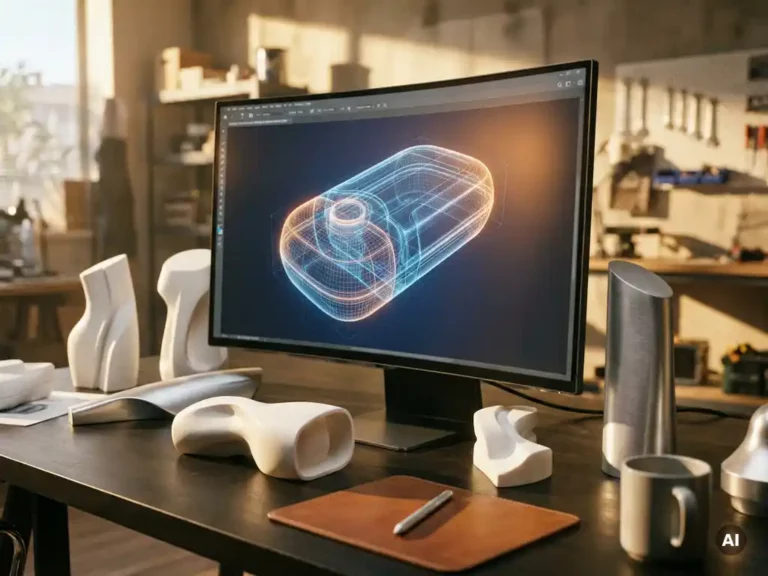
Design is a driver of innovation because it transforms technical capability into products people actually want to buy. When design thinking is embedded early in the development process, it shapes not just how a product looks, but how it functions, how it communicates value, and how it differentiates a company in a competitive market. The following questions unpack exactly how that works across industrial and B2B contexts.
How does design translate technical complexity into market advantage?
Design translates technical complexity into market advantage by making sophisticated functionality legible, trustworthy, and desirable to the people who use and purchase it. A technically superior product that is difficult to understand or visually unconvincing loses ground to a competitor whose offering communicates confidence at first glance. In industrial and B2B markets, this translation is often the deciding factor between a product that wins tenders and one that does not.
The mechanism works on several levels. At the surface level, a well-designed product signals quality and precision before anyone reads a specification sheet. At a deeper level, thoughtful form and interaction design reduce the cognitive load on operators, maintenance teams, and procurement managers alike. When a product clearly communicates its purpose and quality through its physical form, it shortens sales cycles and builds trust faster than technical documentation alone can.
This is especially relevant in sectors like measurement technology, automation, and industrial machinery, where the performance gap between competing products is often narrow. In these markets, design becomes the differentiating layer that makes technical excellence visible and emotionally compelling.
What is the difference between styling and strategic design?
Styling applies visual polish to a product after its core decisions have already been made. Strategic design, by contrast, shapes those core decisions from the beginning, integrating user insight, brand identity, market positioning, and technical constraints into a unified development direction. The difference is not cosmetic. It is the difference between decoration and architecture.
Styling can make a product look more appealing, but it rarely changes how the product performs, how it is perceived in its market category, or how strongly it reinforces a company’s brand. Strategic design does all three simultaneously. It asks questions that go beyond appearance: Who uses this product, and what do they need to feel to use it confidently? What values should this object communicate? How does this product family need to evolve over the next five years?
For industrial companies, the practical implication is significant. A product design strategy built into development from day one produces outcomes that are coherent across the entire product portfolio, not just attractive on a single SKU. It also reduces costly late-stage redesigns, because the design rationale is structurally integrated rather than applied as a finishing layer.
How does design influence buying decisions in B2B markets?
In B2B markets, design influences buying decisions by building perceived quality, reinforcing brand credibility, and reducing purchase risk in the minds of decision-makers. While B2B purchases are often framed as purely rational, the people making those decisions are still human beings who respond to visual and tactile signals of reliability, precision, and professionalism.
Research in industrial purchasing consistently shows that the perceived quality of a product’s design affects how buyers evaluate the company behind it. A poorly designed product raises implicit questions: If they did not invest in the interface and form, did they invest in the engineering? Conversely, a product that communicates design intent clearly signals organizational discipline and attention to detail.
Design also plays a direct role in reducing perceived risk, which is one of the dominant concerns in B2B procurement. When a product looks and feels exactly as capable as it is claimed to be, the buyer’s confidence increases. This is particularly true for capital equipment, measurement devices, and industrial tools, where the cost of a wrong decision is high. Design-driven innovation, in this sense, is as much a sales tool as it is a development discipline.
What role does a holistic design approach play in product innovation?
A holistic design approach plays a foundational role in product innovation by ensuring that user needs, technical requirements, brand values, and market dynamics are addressed together rather than in isolation. When these dimensions are developed in parallel, the resulting product is more coherent, more competitive, and more capable of creating lasting market impact.
The alternative, where engineering, marketing, and design operate in sequential silos, frequently produces products that are technically sound but commercially underwhelming. The engineering team solves the functional problem. Marketing tries to position the result. Design is brought in to make it look presentable. Each step is competent, but the outcome lacks the integration that makes a product genuinely compelling.
A 360-degree perspective on design, one that considers the full context of how a product will be used, purchased, serviced, and perceived over its lifecycle, enables innovation that goes beyond incremental improvement. It opens space for solutions that redefine what a product category can be, rather than simply iterating on what already exists. This kind of systemic thinking is where design and innovation most powerfully intersect.
Which industries benefit most from design-driven innovation?
Industries that benefit most from design-driven innovation are those where products are technically complex, purchasing decisions are high-stakes, and brand differentiation is difficult to achieve through performance alone. This includes industrial automation, measurement and sensor technology, medical devices, mechanical engineering, and professional tools.
In these sectors, the functional performance of competing products often converges over time as technology matures. When that happens, design becomes the primary axis of differentiation. Companies that have invested in industrial design innovation consistently outperform those that treat design as a finishing step, because their products communicate value more effectively, build stronger brand loyalty, and generate stronger emotional responses from buyers and end users alike.
Consumer-facing industries have understood this for decades. B2B and industrial sectors are increasingly catching up, driven by a generation of decision-makers who have grown up with high-quality product experiences and expect the same standard from the tools and equipment they specify for their organizations.
When should a company involve industrial designers in the innovation process?
A company should involve industrial designers at the earliest possible stage of the innovation process, ideally during the definition phase when core product parameters, user requirements, and strategic objectives are still being shaped. Early involvement allows design to influence decisions that are expensive or impossible to reverse later in development.
The earlier design thinking enters the process, the greater its impact on the final outcome. When designers participate in market analysis, user research, and strategic framing, they contribute insights that engineering and product management disciplines may not surface on their own. They bring a perspective trained to identify unmet needs, anticipate user behavior, and envision product experiences that have not yet been articulated.
Late-stage design involvement, by contrast, is typically limited to surface-level decisions. The structural choices have already been made. The result is often a product that is well-engineered but misses the opportunity to be genuinely differentiated. For companies serious about design-driven innovation, the question is not whether to involve designers, but how early and how deeply to integrate their perspective into the core development team.
How code2design helps drive innovation through design
We have spent over 25 years helping industrial companies and technology-driven businesses turn design into a measurable competitive advantage. At code2design, we work with B2B organizations from early strategy through to full product development, embedding design thinking where it creates the most value: at the beginning of the process, not the end.
Our approach covers the full spectrum of what design-driven innovation requires:
- Strategic design positioning: We align product design with brand identity, market positioning, and long-term portfolio strategy so that every product strengthens the company’s competitive stance.
- User and market insight: We translate deep knowledge of end users and market dynamics into design decisions that resonate with the people who buy and use your products.
- Holistic product development: From concept through to production-ready design, we integrate form, function, interface, and brand coherence into a single, unified process.
- Award-winning execution: With over 75 international design awards, our work demonstrates that strategic design and exceptional execution are not in tension. They reinforce each other.
If you want to understand how design can become a genuine driver of innovation in your organization, we would be glad to talk through your specific challenge. Get in touch with us and let us explore what is possible together.
Ähnliche Artikel
- Why do companies need innovation management?
- Why is UX design becoming essential for hardware companies?
- Was ist der Unterschied zwischen UX-Design und UI-Design bei Industrieprodukten?
- Welche Kommunikationsfehler führen zu schlechten Industriedesign Ergebnissen?
- Was sind die häufigsten Produktentwicklungsfehler bei Hardware?