Poor UX leads to product failure in industrial markets because it creates friction at every stage of the user journey, from initial setup to daily operation, driving up training costs, increasing error rates, and ultimately pushing buyers toward competitors whose products are easier to use. In B2B and industrial environments, where operators rely on equipment to hit production targets, a confusing interface or poorly designed workflow is not a minor inconvenience but a direct threat to operational efficiency and profitability. The questions below unpack exactly how this happens and what industrial manufacturers can do about it.
What are the most common UX failures in industrial products?
The most common UX failures in industrial products include overcrowded control interfaces, inconsistent labeling, poor feedback mechanisms, and workflows that reflect how engineers built the product rather than how operators actually use it. These failures are not cosmetic; they translate directly into mistakes, downtime, and user frustration on the factory floor.
In practice, this often looks like:
- Information overload: Dashboards and control panels that display every possible data point at once, making it hard for operators to identify what matters in the moment
- Inconsistent interaction patterns: Controls that behave differently depending on which screen or module the user is in, forcing constant relearning
- Weak error messaging: Alerts that tell users something went wrong without explaining what or how to fix it
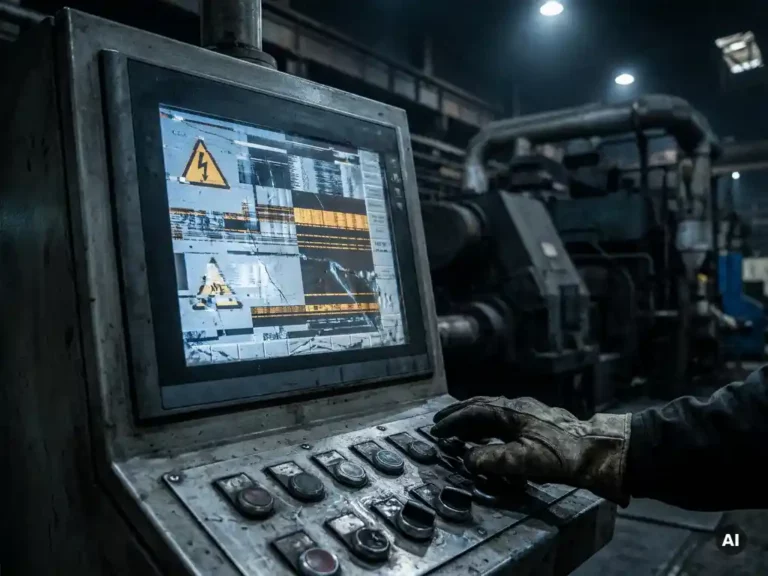
- Ignoring physical context: Interfaces designed for a desktop environment that are then deployed on a factory floor where users wear gloves, work under poor lighting, or operate machinery simultaneously
- Neglected onboarding: Products that assume extensive prior training rather than guiding new users through core tasks intuitively
Each of these failures is avoidable with structured user research conducted early in the design process, before engineering constraints become fixed.
How does poor UX translate into measurable business losses?
Poor UX in industrial products translates into measurable business losses through increased training time, higher error rates, slower task completion, and elevated support costs. When a product is difficult to use, every hour an operator spends struggling with it is an hour of lost productivity, and in industrial settings those hours accumulate quickly across shifts and sites.
The downstream effects compound over the product lifecycle. A machine that requires two weeks of operator training instead of three days adds significant onboarding cost per employee. A poorly designed interface that causes input errors on a production line can trigger quality failures, rework, or safety incidents. Customer support teams spend more time resolving usability issues rather than addressing genuine technical faults.
From a commercial perspective, poor user experience also affects repurchase decisions. In industrial markets, procurement cycles are long, but when renewal time comes, buyers remember how painful the previous product was to operate. Negative word of mouth travels fast within industries where buyers attend the same trade shows and belong to the same professional networks. A product that frustrates its users rarely earns strong referrals, and in B2B markets, referrals carry enormous weight.
Why do industrial manufacturers underestimate UX compared to consumer brands?
Industrial manufacturers underestimate UX compared to consumer brands because they operate under the assumption that professional users will adapt to complex tools, and because purchasing decisions in B2B markets are traditionally driven by technical specifications rather than user experience. This creates a culture where engineering performance is seen as the primary success metric and usability is treated as secondary.
Consumer brands face immediate, public feedback through app store ratings, social media, and return rates. Industrial manufacturers rarely receive that kind of rapid, visible signal. Problems surface more slowly, through support tickets, training complaints, or churn at contract renewal, making it easier to overlook UX as the root cause.
There is also a structural issue: in many industrial companies, the people who specify and procure products are not the same people who use them daily. A procurement manager evaluating a piece of industrial software may focus on feature checklists and price, while the operators who will interact with it eight hours a day have little voice in the decision. This disconnect between buyer and user reduces the internal pressure to invest in industrial product design that prioritizes experience.
What’s the difference between usability and UX in industrial design?
Usability refers to how efficiently and accurately users can complete specific tasks with a product, while UX, or user experience, encompasses the entire emotional and cognitive journey a person has with that product, from first impression through long-term use. In industrial design, usability is a component of UX, not a synonym for it.
A product can be technically usable but still deliver a poor user experience. Consider a control panel where all functions are accessible and labeled correctly, but the layout requires operators to memorize unintuitive sequences, creates cognitive fatigue over a long shift, or generates anxiety during high-pressure situations. The product passes a usability test but fails the broader experience standard.
In industrial product design, this distinction matters because:
- Usability is typically measured through task completion rates, error frequency, and time on task during structured testing
- UX also accounts for confidence, trust, perceived control, fatigue, and how the product fits into the broader work environment
Designing for UX in industrial contexts means understanding the full operational environment, including shift patterns, team dynamics, stress levels, and the physical conditions in which the product is used, not just whether a user can complete a task in a lab setting.
How can industrial companies integrate UX earlier in product development?
Industrial companies can integrate UX earlier in product development by embedding user research into the discovery phase, involving real operators in concept testing before engineering decisions are locked in, and treating UX as a strategic input rather than a final-stage validation step. The earlier UX considerations enter the process, the lower the cost of acting on what they reveal.
Practical steps to shift UX upstream include:
- Contextual user research: Send designers and researchers to observe operators in their actual work environments before any concept is developed. This surfaces real pain points that surveys and interviews alone often miss.
- Cross-functional design teams: Involve UX designers alongside mechanical and software engineers from the project kickoff, not as a handoff recipient later in the process.
- Low-fidelity prototyping: Use paper prototypes, mockups, or simple digital wireframes to test interaction concepts with users before committing to development. Early testing is cheap; late-stage redesign is not.
- Defined UX criteria in project briefs: Establish measurable user experience goals at the start of a project, such as maximum onboarding time, target error rate, or operator confidence scores, so that UX outcomes are tracked alongside technical specifications.
- Iterative feedback loops: Build in structured checkpoints where operator feedback is collected and acted on throughout development, not only at the final review stage.
This approach requires a cultural shift as much as a process change. Leadership must signal that user experience outcomes are as important as engineering performance metrics.
When should an industrial company invest in a UX redesign?
An industrial company should invest in a UX redesign when user complaints about usability are consistent, when training costs are disproportionately high, when error rates on critical tasks remain elevated despite training, or when a product is losing ground to competitors whose interfaces operators prefer. These are signals that the current design is creating friction that cannot be resolved through documentation or support alone.
Other clear triggers for a UX redesign include:
- A product entering a new market where the user profile differs significantly from the original target audience
- A major software or hardware update that changes the interaction model without a corresponding rethink of the user experience
- Declining customer satisfaction scores that correlate with product interaction rather than product performance
- Regulatory or safety requirements that demand clearer operator feedback and error prevention
A redesign does not always mean starting from scratch. In many cases, a targeted intervention, such as restructuring a key workflow, simplifying a primary interface, or improving error messaging, can deliver significant improvements without a full product overhaul. The key is to base the scope of the redesign on actual user research rather than internal assumptions about where the problems lie.
How code2design helps with UX in industrial product design
We work with industrial manufacturers to close the gap between engineering capability and user experience, applying a holistic 360° design approach that brings operator insights, market knowledge, and technical expertise together from the earliest stages of product development. Rather than treating UX as a finishing layer, we integrate it as a strategic driver that shapes product decisions from concept through to market launch.
Our approach to industrial UX includes:
- In-depth user and context research to understand how operators actually work, not just how they are expected to work
- Interface and interaction design that reduces cognitive load, supports error prevention, and fits the physical realities of industrial environments
- Prototyping and iterative testing with real users before engineering resources are committed to a direction
- Full-service product development that connects UX design with industrial design, mechanical engineering input, and brand strategy
- Strategic portfolio review to identify where UX improvements will have the greatest commercial impact across a product range
With over 75 international design awards and more than 25 years of experience in industrial and product design, we bring a proven track record of creating products that perform technically and resonate with the people who use them every day. If your product is losing ground because of user experience, or if you want to build UX strength into a new development from the start, get in touch with us and let’s talk about what the right approach looks like for your product.
Ähnliche Artikel
- How do you integrate augmented reality into industrial UX?
- Why is UX design becoming essential for hardware companies?
- How do you avoid misunderstandings with commissioned industrial designers?
- How do you document industrial design services for accounting?
- How do you develop products with a limited budget?